After the dense and wonky first and second parts of this series, I’m hopeful that the rest of the series will tie things together and illustrate how a serviceable understanding of basic travel hacking concepts really can provide incredible value for spectacularly luxurious travel to interesting and exotic places.
Fly me to the moon
Here’s where the rubber finally meets the road: the backbone travel for this trip. What I mean by “backbone” is long-haul travel — thousands of miles at a time between countries and continents. This travel was booked as a single US Airways award from New York to Tokyo and back with a 14-day stopover in London in the middle.

Melissa enjoying some wine in the British Airways lounge at Newark Liberty International Airport.
I wanted to fly these legs of our journey in First/Business class since there is so much value there (both in terms of money and comfort). Not the least of these comforts is airport lounge access. If you’ve never experienced a high-quality airport lounge before a flight, it’s a wonderful experience. Free food and drinks (including good, full-service restaurants and bars in some), free Wi-Fi, full shower facilities, clean bathrooms, comfortable seating, desk and computer space…you name it!
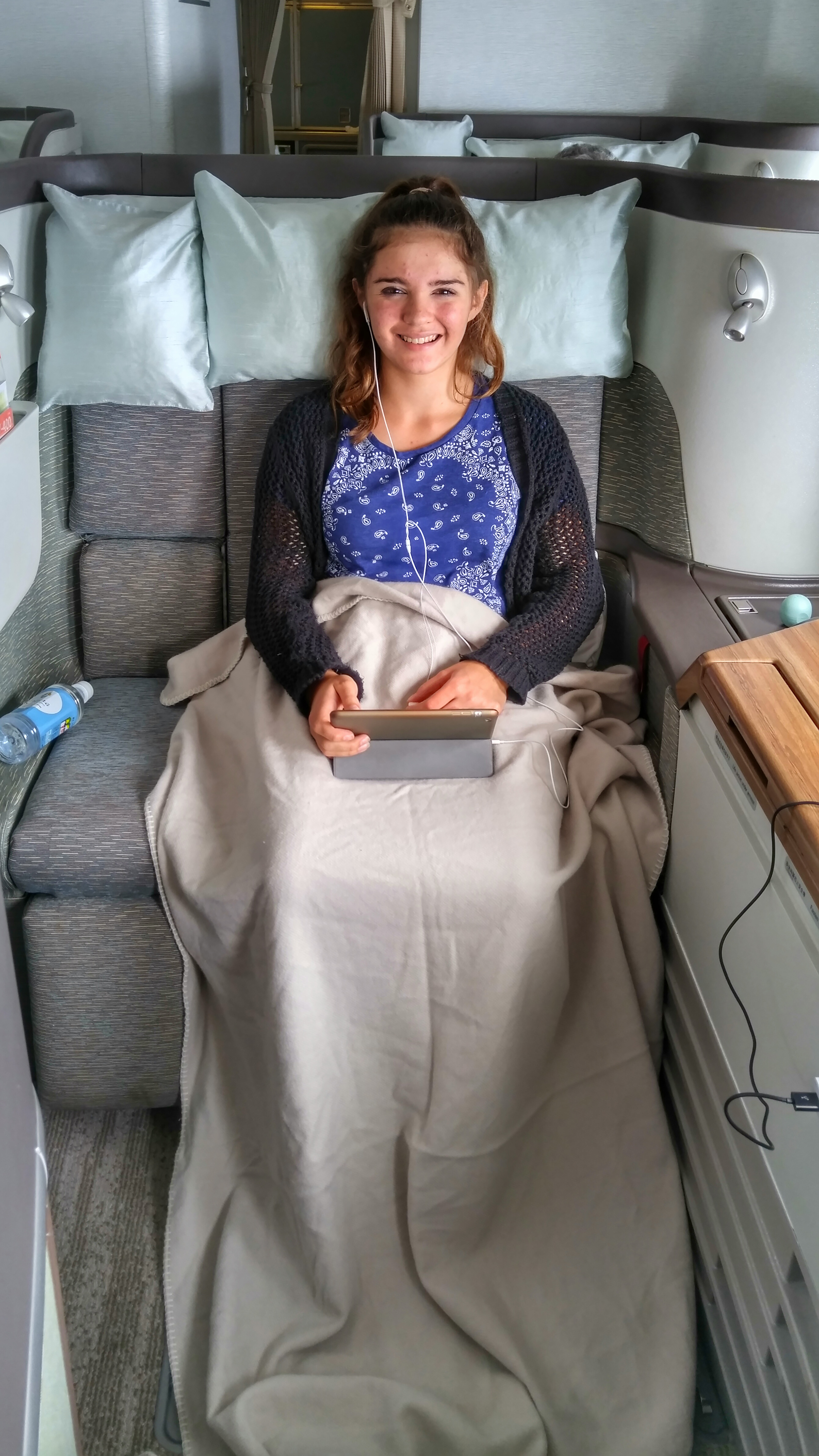
And once you’re on the plane, First/Business class is SO worth it. First of all, a lie-flat bed on 8 to 16 hour flights is almost a requirement. Not to mention the food, the drinks, the amenities, the lounge access, the movies, the service, the priority boarding, the space – it’s an experience everyone should have. We are lucky to have been able to do it and even more lucky to share it with the kids. By contrast, all our inter-Europe travel was standard coach class, and it was a relatively miserable experience. (first-world problems)
BACKBONE TRAVEL
- Overview: The backbone of our trip was a set of four first- and business-class tickets purchased using 120,000 US Airways miles each for round-trip travel between New York and Tokyo with a stopover in Europe.
- Strategy: I chose US Airways because we wanted a round-the-world trip

Abby enjoying some of the perks of Cathay-Pacific first class service.
that included Europe and Asia. At the time we booked, US Airways’ routing rules specifically allowed for a single stopover of up to 30 days on an international round-trip itinerary. So, I created an itinerary that was essentially: NYC – London – *14 day stopover* – London – Hong Kong – Tokyo – Hong Kong – NYC. During the 14 day stopover in London, we traveled to Paris, Geneva, Montreux, Amsterdam and back to London using different points and outside of our main itinerary. Think of those as “side trips” which I will outline later.
Although we used US Airways points, all travel was booked on US Airways’ partners, British Airways and Cathay Pacific. You’ll recall from Part 2 of this series that fixed points are always governed by the rules of the program in which they’re earned. In this case, the airfare was booked under US Airways’ frequent flyer program, so the rules of US Airways’ frequent flyer program govern the award. In other words, the rules of the frequent flyer program you’re booking under apply, not the actual airlines you’re flying.
So, it doesn’t matter if British Airways or Cathay Pacific allowed stopovers on transatlantic flights. US Airways did and I was using US Airways points to book the award, so the 14-day stopover in London was valid. Weird, I know, but that’s how it works. And that’s where an understanding of the sweet-spots of the different programs can really come in handy.
- Airfare Class: First/Business – lie-flat beds and full airport lounge access for all segments.
- Airfare Points Earning: We needed a pretty large number of miles (480,000) pretty quickly to travel via First/Business class, so unfortunately we had to purchase some miles for the kids in order to pull it off. Melissa and I each earned 150,000 points by opening two co-branded Chase US Airways credit cards (one personal, one business) with 75,000 mile signup bonuses. The minimum spending required to earn the points was something like $5,000 on each card over three months. Again, the minimum spend is the amount you need to spend on the card in order to earn the promised bonus. It is a threshold that must be reached.By putting everything you can think of on the card and shifting all spending to where it is needed, a family of four can usually handle this process. Once completed, this gave us each roughly 160,000 AAdvantage miles in each of our accounts.The kids were a bit trickier, but US Airways came out with a 100% buy/gift miles bonus right when we needed it. A buy/gift miles bonus allows program members to buy miles for themselves or pay to gift them to others. In so doing, the bonus miles percentage is applied to the recipient’s account in addition to the amount purchased or gifted. So, for example, gifting 25,000 miles to a family member would result in a 50,000 mile deposit to their account.These bonuses are generally not worth participating in speculatively just to build your point or mileage balances, but when you have a specific, high-value redemption in mind, they can be incredibly valuable and help build balances quickly.
We registered each of the kids with their own US Airways accounts and we each transferred 100,000 miles to a child. With the bonus, each kid had 200,000 miles in their account. We then transferred 50,000 miles *back* to each of our accounts, again earning the transfer bonus and resulting in 100,000 miles being deposited into each of our accounts. These transfers were explicitly allowed by the terms of the promotion, but it could only be done once per account each way.
At the end of the day, Melissa and I each had 160,000 miles in our accounts and Abby and Andy each had 150,000 miles in their accounts – more than enough for the four tickets we needed.
- Airfare Points Spent: 120,000 points per ticket x 4 tickets = 480,000 points total.
- Airfare Cash Spent: The cost to do the transfers back and forth was roughly $1,100 each for a total of $4,400 for four travelers.
- Airfare Value: At the time of booking, the face value for the tickets was roughly $33,000 each for all segments or roughly $132,000 in value.
- Airfare Value Per Point: The standard for deciding the value of any particular redemption is called value per point. It is calculated by subtracting the cash you contributed from the cash value of the ticket (or hotel room) and dividing that by the number of points or miles used for the redemption. In this case:
($133,000 – $4,400) / 480,000 = $.27 per point
Generally speaking, points are valued in fractions of a cent (say, .5 cents to 2 cents per point), so wringing more than 25 cents per point out of an award is an epic win. Like, really, really huge.
English, please?
In English, this means we opened a total of four credit cards and spent $4,400 to get more than $133,000 in first/business class airfare between 3 continents. Sweet.
Part 4 will begin the focus on each city along the way. I will be covering hotel stays in this series, but I will do that in the posts for each city. That said, I decided that two rooms per night was mandatory everywhere we went – one for us, one for the kids. This effectively doubled the number of points required for lodging, but European hotel rooms are notoriously tight (although all of ours were really quite large) and I didn’t want to risk starting each day off with a morning battle over the bathroom. Parents of teenage daughters will understand. Thankfully, all but one of the places we’ve stayed gave us adjoining rooms, most without asking for it.
Series Links:
- 2015 Epic Summer Vacation – Part 1: Introduction
- 2015 Epic Summer Vacation – Part 2: Travel Hacking Primer
- 2015 Epic Summer Vacation – Part 3: Backbone Air Travel (You Are Here)
- 2015 Epic Summer Vacation – Part 4: Paris
- 2015 Epic Summer Vacation – Part 5: Switzerland
- 2015 Epic Summer Vacation – Part 6: Amsterdam
- 2015 Epic Summer Vacation – Part 7: London
- 2015 Epic Summer Vacation – Part 8: Japan
- 2015 Epic Summer Vacation – Part 9: Hong Kong
- 2015 Epic Summer Vacation – Part 10: NYC
 Jim Meets World
Pingback: 2015 Epic Summer Vacation – Part 4: Paris | Jim Meets World
Pingback: 2015 Epic Summer Vacation – Part 1: Introduction | Jim Meets World
Pingback: 2015 Epic Summer Vacation – Part 2: Travel Hacking Primer | Jim Meets World